Genomics
7 min read
By BioBuilt Editorial
Genomics
7 min read
By BioBuilt Editorial
Every cell in your body carries roughly three billion letters of genetic code. Change just one of those letters, and the consequences can be devastating. A single misplaced nucleotide can cause disorders such as sickle cell disease, cystic fibrosis, or Huntington's disease. For decades, physicians could do little more than manage the symptoms of these conditions. The faulty instructions remained permanently written into a patient's DNA.
Today, that is beginning to change.
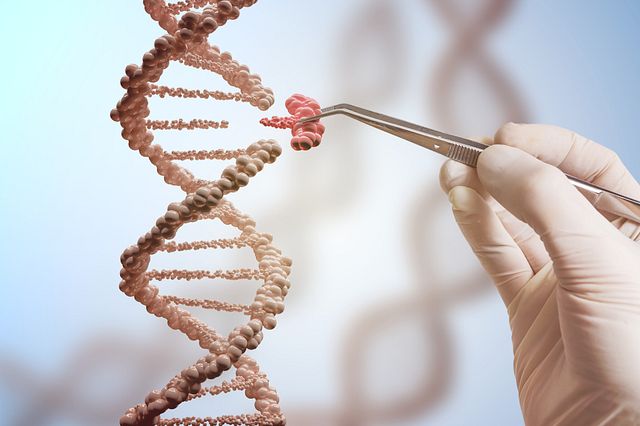
Rather than treating the consequences of genetic disease, biomedical engineers and molecular biologists are developing technologies that can edit the genetic instructions themselves. What began with a bacterial defense mechanism known as CRISPR has evolved into an entirely new field of precision genetic engineering. Increasingly, the goal is no longer simply to cut DNA, but to rewrite it with the accuracy of a word processor correcting a typo.
Ironically, one of medicine's most revolutionary technologies was never designed for medicine at all.
For billions of years, bacteria have defended themselves against invading viruses using an adaptive immune system known as CRISPR. When a virus infects a bacterium, fragments of the viral DNA are stored within the bacterium's own genome. If the same virus attacks again, specialized proteins recognize the matching sequence and destroy the viral DNA before the infection can spread.
Researchers realized this natural defense system could be redesigned for an entirely different purpose.
At the heart of the system is a protein called Cas9, which functions like a pair of molecular scissors, and a short piece of guide RNA, which acts like a GPS, directing Cas9 to a precise location within the genome. By simply changing the guide RNA sequence, scientists can redirect Cas9 to almost any gene they choose. In essence, researchers transformed a bacterial immune system into a programmable molecular tool capable of editing human DNA—a remarkable example of engineering a biological system to solve a completely different problem.

CRISPR is often described as a gene-editing technology, but it is equally an engineering platform.
Once Cas9 reaches its target, it cuts both strands of DNA. The cell immediately attempts to repair the break using its own repair machinery, and scientists can harness that process to disable genes, insert new DNA sequences, or correct disease-causing mutations.
The technology transformed biomedical research almost overnight. Laboratories that once required years to genetically modify cells could suddenly edit DNA with unprecedented speed and precision. In 2023, the first CRISPR-based therapy received regulatory approval for treating sickle cell disease, demonstrating that gene editing had progressed from laboratory research to clinical medicine.
Yet like every first-generation technology, CRISPR also revealed its limitations. Many inherited diseases result from changing only a single letter of DNA. Making a complete break in the chromosome to correct one tiny mistake can sometimes introduce unintended edits or rely on repair mechanisms that behave unpredictably. The next challenge was no longer simply whether scientists could edit genes—it was whether they could do so with even greater precision.
The search for greater precision led to an entirely new generation of gene-editing technologies.
One of the most important advances is base editing. Instead of cutting both strands of DNA, base editors chemically convert one DNA letter into another, much like correcting a spelling mistake without ripping the page in half. Because many inherited diseases are caused by single-letter mutations, this approach allows researchers to correct genetic errors while avoiding the double-stranded DNA breaks required by traditional CRISPR.
For mutations that require more extensive changes, researchers developed prime editing. Rather than functioning like molecular scissors, prime editing operates more like a word processor's search-and-replace feature. It locates a specific DNA sequence and rewrites it according to precise genetic instructions, allowing scientists to insert, delete, or replace DNA with far greater flexibility. Together, these technologies represent an important shift in biomedical engineering: from cutting DNA toward programming it.

Ironically, editing DNA is no longer the hardest part.
Before any gene editor can repair a mutation, it must first reach the correct cells inside the body. Delivering large molecular machines like CRISPR safely through the bloodstream, avoiding healthy tissues, and ensuring they remain active only where needed has become one of the defining engineering challenges of modern genetic medicine. Researchers are developing viral vectors, lipid nanoparticles, and other delivery systems designed to transport gene-editing tools with increasing precision.
In many ways, these delivery technologies are just as important as the editors themselves. A perfectly accurate gene editor has little value if it cannot safely reach its target.
Gene editing is already beginning to reshape clinical medicine. Patients with sickle cell disease have received CRISPR-based therapies capable of dramatically reducing the painful crises that once defined their lives. Researchers are investigating treatments for inherited blindness, muscular dystrophy, blood disorders, and certain cancers, while experimental therapies are exploring whether gene-editing medicines can be custom-designed for patients with rare mutations.
These advances reflect a broader transformation in medicine. Rather than compensating for faulty genes with lifelong treatments, physicians may increasingly be able to repair the underlying instructions themselves.
Gene editing remains one of the fastest-moving fields in biomedical engineering. Questions surrounding long-term safety, immune responses, delivery, accessibility, and ethics remain active areas of research. Scientists are also developing entirely new technologies—including RNA editing, epigenome editing, and programmable gene-writing systems—that extend beyond today's CRISPR-based approaches.
Even so, one idea has become increasingly clear. CRISPR did more than give scientists a new laboratory tool. It fundamentally changed how researchers think about disease. A genetic mutation is no longer viewed only as a problem to manage, but increasingly as an engineering problem that may one day be corrected.
For decades, medicine treated diseases written into our DNA. Biomedical engineering is beginning to rewrite the story itself.
Anzalone, A. V., Randolph, P. B., Davis, J. R., et al. (2019). Search-and-replace genome editing without double-strand breaks or donor DNA. Nature, 576(7785), 149–157. https://doi.org/10.1038/s41586-019-1711-4
Doudna, J. A., & Charpentier, E. (2014). The new frontier of genome engineering with CRISPR-Cas9. Science, 346(6213), 1258096. https://doi.org/10.1126/science.1258096
Food and Drug Administration. (2023). FDA approves first gene therapies to treat patients with sickle cell disease. https://www.fda.gov/news-events/press-announcements/fda-approves-first-gene-therapies-treat-patients-sickle-cell-disease
Gaudelli, N. M., Komor, A. C., Rees, H. A., et al. (2017). Programmable base editing of A•T to G•C in genomic DNA without DNA cleavage. Nature, 551(7681), 464–471. https://doi.org/10.1038/nature24644
Jinek, M., Chylinski, K., Fonfara, I., Hauer, M., Doudna, J. A., & Charpentier, E. (2012). A programmable dual-RNA-guided DNA endonuclease in adaptive bacterial immunity. Science, 337(6096), 816–821. https://doi.org/10.1126/science.1225829
Komor, A. C., Kim, Y. B., Packer, M. S., Zuris, J. A., & Liu, D. R. (2016). Programmable editing of a target base in genomic DNA without double-stranded DNA cleavage. Nature, 533(7603), 420–424. https://doi.org/10.1038/nature17946
National Human Genome Research Institute. (n.d.). CRISPR Fact Sheet. https://www.genome.gov/about-genomics/fact-sheets/CRISPR-Fact-Sheet
National Institutes of Health. (n.d.). CRISPR: A game-changing genetic engineering technique. https://www.nih.gov/about-nih/what-we-do/nih-turning-discovery-into-health/crispr-game-changing-genetic-engineering-technique
Wang, D., Zhang, F., & Gao, G. (2020). CRISPR-based therapeutic genome editing: Strategies and in vivo delivery by AAV vectors. Cell, 181(1), 136–150. https://doi.org/10.1016/j.cell.2020.03.023\
monthly newsletter
Get one monthly simplified summary of the healthcare headlines, research findings, and biotech developments worth understanding.